
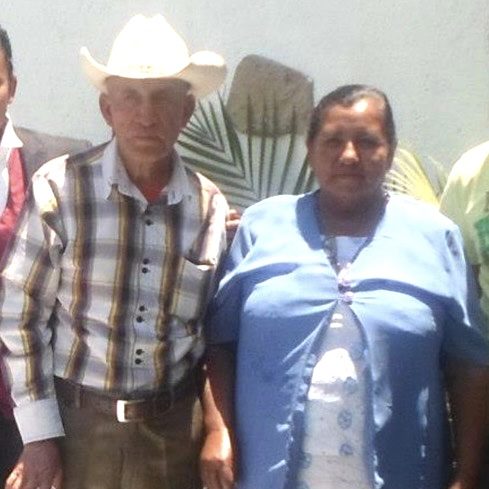
Will this nightmare ever end? the young girl wondered as she covered her head once again, awaiting the blow that was sure to follow. Her husband spared her no sorrow during his drunken outbursts, which normally ended with a beating. In a sense, Liduvina was used to this kind of life. Growing up, her father had not always treated her lovingly. It was hard to imagine, though, how a man could so quickly turn around and beat the girl he had worked so hard to acquire. Felipe had been insistent on marrying her, despite the odds, which first of all, included her 14 years of age, opposed to his 21. Secondly, there was Liduvina’s own fear of Felipe, with no inclination toward even wanting to be close to him, much less marry the man. Finally, there was her father’s fierce insistence on sticking to the old, traditional customs of marriage and purity. In spite of these barriers, Felipe had stopped at nothing to get his bride.
It had all started one hot day in the late summer. Lidu was walking across the street to her grandma’s house, when she got the uneasy feeling that someone was watching her. She glanced nonchalantly up the street but looked quickly away when she realized her eyes had been met by those of a mysterious looking man. She shivered and hurried into her grandma’s house, trying to ignore the cold stare that followed her. She wanted to forget the stranger with his rude stare, but much to Lidu’s dismay, during the following days, that same man kept on watching her from up the street. She felt unnerved by this stranger and knew she had to keep her wits about her to avoid being “stolen” like many of the other girls in her village.
It was common practice in rural Mexico at that time, for a man who saw a girl he liked, to just “kidnap” her to be his wife. Some girls were fortunate enough to end up with a relatively decent husband who gave them food and treated them fairly. Others suffered the fate of abusive men who treated them more like slaves than wives. Of course, many girls didn’t show any resistance upon being “stolen”, as they had previously flirted and found one another’s company quite agreeable. But there were always those stories, like that of a twelve-year-old girl who had gone down to the river to draw water. All of a sudden, she had been surrounded by the prospective groom and his buddies, who literally “kidnapped” her, giving her no way to resist or be rescued.
Of course, Lidu wanted to be one of the fortunate ones who was chosen by someone kind and good, but she knew she would have to be wary of this stranger with his cold stare. No going out alone at night, she told herself. Nor most anywhere, for that matter. she added.
But in the end, even when she had taken these precautions, she could never have imagined the nerve of the fellow up the street.
“Give me a box of cigarettes” the man demanded in a dry tone.
Lidu quickly turned to find the cigarettes, trying the whole time to avoid eye contact. She didn’t know much about this man, only that he was good at staring and that he was much older than herself. After paying for his purchase, Felipe left and turned a corner, disappearing from the sight of the young girl attending her grandmother’s tiendita (little store). Lidu was glad he had gone and was about to sit down next to her dozing grandmother, who had been sitting in a chair near the entrance of the small room, her head bent, and her feet spread comfortably over the whole width of the door. Suddenly, out of nowhere, Felipe bounded over Grandma’s feet and grabbed Liduvina by the hand and began dragging her out of the store. Well of all the nerve! thought Lidu as she desperately tried to wiggle her hand free of the stranger’s strong grip. It became an awkward sort of tug-a-war as Felipe pulled and Lidu resisted. By this time Grandma had lifted her head and could now see exactly what was happening. That soon put an end to Felipe’s daring plan of stealing his bride. At least for the moment, he thought to himself as he blankly left the tiendita, deciding to wait until a more opportune time. But the deed had been done, and there was no reversing the fact that he had grabbed her hand.
Much to Lidu’s mortification, she found herself between a rock and a hard spot. In rural Mexican culture at that time, holding hands was viewed as something unforgivable, and there was only one thing to do with the two who had done such an inappropriate thing—they must get married. Lidu’s father had found out that a man had touched his daughter and assured Lidu that if she was not in agreement with marrying the offender, he would kill him.
Lidu was so afraid. She had heard that God could not forgive assassins, and if she told her father the truth, that she was not interested in Felipe, she would be responsible for someone’s death. This troubled her so much she decided to lie, and told her father she was interested in the stranger.
Sometime later, Felipe formally asked for Lidu’s hand in marriage.
Lidu tried buying time by asking for six months to consider the marriage proposal. In the meantime, she made plans to escape to Mexico City. But the plans fell through, and at the end of six months she found herself forced to say yes to a man she didn’t love.
“Mama, I’m hungry,” pleaded the little boy. Lidu looked down into a pair of big dark eyes, much like her own. She forced back a tear and tried to suppress the hunger gnawing at her own stomach. She gathered her little band of children around her and gave careful instructions. “You must only pick the plants that look like this,” she showed them. The 8 hungry children spread out over the field and soon had found many bunches of the plant their mother had pointed out. It certainly was no feast, but they were grateful for something to put into their growling stomachs, and it was better than nothing.
This was normal life for Lidu and her children. The family lived with Felipe’s mother, who took special pleasure in making her young daughter-in-law’s life as miserable as possible. She would wait for her son to come home and would hand him a belt to beat his wife. Lidu slept on the hard dirt floor at night, and just toward bedtime, her mother-in-law would decide the floor needed a good washing and would pour a bucket of water right over the place where Lidu was to sleep, turning the dirt into mud.
She didn’t even have the least bit of compassion on her grandchildren. When Lidu’s mother would come to bring milk and some other basic supplies, Felipe’s mother would take the things and throw them to the ground right in front of the astonished woman, yelling, “Not to them! I don’t want anyone to give them anything!”
Felipe always seemed to be drunk. He would spend his meager income on alcohol, leaving his children with empty stomachs. They would later recall going days without a decent meal. Their mother would take them in the mornings to the mountain where they could scavenge for plants. If they were lucky enough to find nopales (an eatable cactus) or tunas (a fruit which comes from the nopal plant,) they would eat that, but much of the time it was just small raw plants. In the evenings they would return to the house and go to sleep, only to awaken to the same routine the next day.
The family finally moved to a plot of land Felipe owned not far from his parents’. While there, he became seriously ill and was rushed to the doctor, just to be told that he had cirrhosis, and that if he ever drank one more alcoholic beverage, he would die. This was enough to shake Felipe to the point of never touching alcohol again.
The land didn’t bare the crops the family had hoped for, so they found themselves forced to move yet again, this time to the nearby city of Irapuato. There, Felipe began trying to scrape out a living selling cups of fruit on the street. Life was not so rough for the family now that Felipe had stopped drinking and had begun making an honest living. Years went by and the children became adults. Felipe had gotten work in the police department and his oldest son, Jesús, followed in his father’s footsteps, becoming a police officer.
BUT THEN CAME JESUS…
One day, when Felipe and Lidu’s son Jesús went to visit his in-laws, he found two other people at their home teaching them the Bible. Wait a minute, thought Jesús as he looked more intently at one of the men sitting there. It couldn’t be, it just couldn’t be. But it had to be. Jesús would recognize that man anywhere. As a police officer, he became familiarized with many of the men in the city who were always getting in trouble. But he couldn’t understand what this man was doing in his in-law’s living room with a Bible in his hand. It seemed too impossible to believe that a person with his background and habits could change so drastically. Jesús decided to inquire what could have brought about such a transformation. The former thief explained that Christ had come into his life, and he was now a changed man. This amazed Jesús. Could the Bible really be that powerful? He wanted to find out. So, he began reading the Bible for himself. At work, he met a man named Armando, and found out he too was a Christian. Armando offered to study the Bible with Jesús and his family, along with Felipe and Lidu and the rest of the children. Sunshine or rain, Armando never missed a study. He was faithful. Through this, many of Felipe and Liduvina’s children including Jesús, came to place their faith in Christ for their salvation. Lidu herself also decided to come to the Savior as a result of the Bible studies. She rested her weary soul on the One who promises to give rest to all who come to Him.
Most all the family was born again into a heavenly family. Most, but not all! Felipe hesitated, but the Lord would not give up on him. Through a series of incidents which involved nearly losing his life several times, Felipe finally surrendered his life to the Savior. He became a changed man. The Lord had certainly done a miracle in the life of this broken and dysfunctional family. That miracle came about through Jesus, Who offers full and free forgiveness to all who receive Him as their Savior.
The years passed and Felipe’s parents grew old. As they went through the unpleasant experience of having to depend on others to care for them, an amazing thing happened. Felipe and Lidu, who had suffered so much at the hands of this evil woman, took Felipe’s mother and father in, and cared for them until their very last days. Lidu told me how Jesus had taken away the bitterness she held toward her husband and her mother-in-law. It was simply gone. In its place remained His love, which reached out to those who had mistreated her the most. It’s a love the world cannot comprehend. Nonetheless, Felipe and Lidu’s story is just another proof that God’s love is real and powerful. Why wait any longer? His arms are open, and the invitation is clear. “Come to Me, all who are weary and heavy laden, and I will give you rest.”
Epilogue: Felipe and Lidu’s story depicts “Old Mexico” in an accurate way. The “stealing” of the bride was, in some places, literal back then and the phrase even now, continues to be used in rural areas for young couples running off together. But as it is used today, it basically means “eloping.”
Felipe and Lidu now live in the large city of Irapuato. They attend most all our camps and evangelistic events in spite of the difficulty this represents for Lidu, who struggles to walk. Felipe is known to go around and empty all the trash cans during camps. He loves serving in this way. At 77 years of age, he has memorized 180 verses of Scripture, which he constantly uses in his faithful witness to non-believers and also, as he shares uplifting messages with the believers in his church. He carries a handful of tracts with him as he goes out and is on the look-out for opportunities to share the gospel. He declares that we must be about the business of the gospel because the Lord is coming soon!
All their children have come to faith in Christ except one who was involved with, and then killed by the mafia several years ago. Their oldest son Jesús, and his wife, Delia, have been used by the Lord to begin a church on the south side of Irapuato, and Felipe and Lidu are a blessing there. Miguel (the third oldest son) and his wife Abril attend our church at Camp Berea, but live in Charo, a nearby town. Their goal is to share the gospel with people in this fanatically religious and hardened town. They have seen several come to the Lord through their faithful witness there. They hope one day to begin a solid Bible church in this place. One of Felipe and Lidu’s grandchildren, Chucho, (Jesús’ oldest son) moved recently, with his wife Karla and young boys, to the nearby city of Moroleón to share the gospel there, in hopes of seeing the beginning of a Bible church.