
“You’ve got to be crazy,” Rosi looked incredulously at the woman in front of her, who was holding a Bible and gazing earnestly at her. “What do I possibly have to thank God for?”
Monica looked lovingly at the woman in a wheelchair, her face hardened and weathered from years of suffering and toil. “God tells us in His Word to be thankful under all circumstances,” she replied, smiling yet knowing that what she was saying made little sense to someone who had lived the life Rosi had. Rosi shook her head. “God has done nothing good for me. All I’ve ever gotten in life is hardship. No,” she turned her wheelchair towards the door, “I could never thank God.”
__________________
“Rosi,” the weak whisper of her mother woke thirteen-year-old Rosi with a start. She quickly jumped up, limping to her mother’s bedside.
“Sí, Mamá?”
“I need some water,” she wheezed.
“I’ll get it right away, Mamá,” Rosi hurried the best she could out the door to the kitchen. When she returned, her mother looked like she was asleep. Rosi put the cup on the table and sat down again, watching as her mother’s chest heaved up and down under the covers, her eyelids fluttering, her mouth slightly open, sucking in the stuffy air.
What time was it? Rosi was tired. As she looked out the little window, she could see the dawn breaking across the mountains surrounding Puruándiro, her hometown and the only world she knew.
“Rosi?” Rosi turned her attention to her mother, bringing the cup to her lips, gently pouring the cool liquid down her throat.
“Rosi, I must talk to you. Before the other children wake up.” Her mother paused a moment, then continued, “I’ll be leaving you soon. You, your siblings–you will be like abandoned chicks. Remember Rosi? How the mother hen leaves the baby chicks when they’re old enough to fend for themselves. How the chicks cry. They can’t find the mama hen.”
“Mamá, stop that! Why are you saying this?” Rosi didn’t understand. She didn’t want to, either. How could their mother leave them? Tears began streaming down her mother’s face.
“You must remember everything I’ve taught you these past months. Yes? How to make the tortillas and the beans. You must take care of your brother and sisters. You’re the only one that can. Wash their clothes, yes? And keep the house,” her mother choked and sobbed.
“Mama, please—“
“You must listen, Rosi. I won’t be here much longer. You have to be their mother.”
Rosi was angry. “But I don’t want to!”
“You must. Promise me this, Rosi—” her mother looked deeply into her eyes, “Never let them separate you and your siblings, you hear? You must stay together. Don’t let them separate you.” With that she leaned back on the pillow and cried for a good while.
Rosi stood watching helplessly. She didn’t like this. She didn’t like it at all. What was happening with her mother? Why was she saying these strange things?
Take care of her siblings? It seemed like an impossible task. They were six in all. First Elisa. She had been born with a mental illness and wasn’t well. Then Rosi. She was born with disfigured feet, nearly crippled. She could only hobble about, but at least she was sane. Then Gustavo. He was also sick. Then Ruby. She was the only child that was completely normal. Then Elena, also sick. And finally Eva, who was only six months old, also sick. Rosi was the only one who could take responsibility. Ruby was young, and the rest had mental disabilities. People wondered what had made their mother have so many disabled children. She was strong, though, taking good care of them all. Since she had been diagnosed with breast cancer, things had gone downhill. In the six months that followed, Mamá did the best she could to prepare Rosi for the work of mothering her five siblings. She taught her everything she knew. Rosi had not understood why, and complained about the work. But now. Now what?
As the day progressed Rosi helped dress and feed her siblings, limping back and forth from her mother’s room as she checked on her. Rosi’s aunt came later that morning to help. Her father was busy tending his pig business.
Her mother’s words echoed in her mind as she heaved the laundry to the patio. She would leave them. They would be alone. They would have no one to soothe them when they were frightened or tend to their hurts. She shook her head. It couldn’t be.
Rosi helped her aunt prepare the meal. Her father came in the door in time to eat. He looked weary. After eating silently, he rose and entered the bedroom where his wife lay, the life slowly seeping out of her. He knew. How Rosi hoped he could do something, something to keep Mamá from leaving them. But even he couldn’t.
A few days later Mamá was gone. As preparations were made for the funeral, Rosi sat on the steps and gazed out on the courtyard where the pigs were sunning themselves while the chickens pecked at the ground for food. A little flock of chicks caught her attention. They ran around screeching, searching for their mother in confusion. As Rosi stared at them she remembered her mother’s words. “Like abandoned chicks.”
After their mother’s death Rosi and her siblings moved to live with their aunt, their mother’s sister, who herself had already experienced enough hardship for one year. Her husband, mother, and now sister, had all died within that year. She had been left with two young children, and the burden of six more was enough to make her sour. Rosi’s father began going to the States more frequently to work. Rosi hated life with her aunt. There wasn’t enough food to go around. Her aunt treated them harshly. And of course, it was a daily challenge to care for her siblings. But she held to the promise she had made to her mother. They all stuck together.
“Come on, Gustavo,” Rosi urged her grinning brother as they trudged together down the street. “We have to be back in time for supper.” Rosi tried to go faster, but her limp did not make it easy. Gustavo was pushing the wheelbarrow with the dirty clothes they needed to wash at the hot springs a few miles from the house. Rosi avoided looking at the people they passed. Children would often openly stare at them. Women quickly turned away; others glared with stinging scorn. Boys would sometimes shout insults after them and laugh. It was almost unbearable. Gustavo didn’t seem to notice or understand the deriding comments, but it pained Rosi. She dreaded every time they had to walk through town.
They finally found a lonely spring and squatted down together. Gustavo, grinning the whole time, would dunk the clothes in the water and pass them to Rosi who would scrub them with soap on a washboard. It was hard work. The sun beat down on them and Rosi’s back ached from bending over. An hour or so later they piled all the washed clothes back in the wheelbarrow. It was heavier now that the clothes were wet. Rosi tried to help Gustavo with shoving it through the mud and back onto the street. Right then a rock sailed through the air, missing Gustavo’s head just by an inch. Rosi spotted the boys behind a tree, snickering. Fury rose up within her. “Scram!” she yelled, her eyes flaming. They scampered off, chanting insults. Tears stung Rosi’s eyes. Gustavo just looked at her sheepishly. “Come on,” she muttered, grabbing one of the handles of the wheelbarrow.
As they walked Rosi thought of a conversation she had had with her two friends, Maria and Lupe, the other day. They went to mass frequently and studied the catechism. They told her that she must be grateful to God. Rosi scoffed. She wasn’t even sure if there was a God. And if there was, she certainly had nothing to thank him for. Everything had gone wrong in her life. She was born a cripple. Her mother had died. She led a miserable life with an angry aunt, her father far away. What was there to be thankful for?
They got to the humble house just as the sun was lowering in the sky. Her aunt was cooking a small pot of beans, grim as always. The moment Rosi entered she said sharply, “It’s about time you’re back. Your sister is throwing a fit. Go help her.” Rosi silently and slowly made her way down the passage to the room where her sister was crouched in a corner. Her knees were brought up under her chin and she was rocking back and forth, mumbling, and shaking her head. Rosi was the only one that could calm her when she had fits like this. She could tell it was going to be a long night.
Life went on; Rosi’s father came and went from the States; the tension grew in her relationship with her aunt, and it was a struggle to finish her education, with her feet getting worse. It got to a point where Rosi felt she had fallen in a deep well. She didn’t know what to do. Wherever she turned there was strife and sadness. Her aunt would not stop nagging and fighting with her. Her siblings continued in the same condition. There was no comfort, no refuge.
__________________
When Ruby was older, she began to work, and with the extra money coming in, things got a little better. However, this created a restlessness in Rosi. She had to do something. She couldn’t just sit and let life pass by. She began taking knitting and sewing classes. She busied herself making sweaters and school uniforms. It was the little bright spot in her life. She was productive–and also distracted–from her troubles.
She had a very good teacher who also became her good friend. Her name was Carmelita. Rosi noticed that she would always stay after class, sitting at her desk. Rosi would stay late, watching her. She would ask her what she was doing, and Carmelita would always answer, “Something very good.” After more insistence from Rosi, she once showed her a Bible. “Look, this is what I’m reading. It has a great message for us all. See, it says here in this verse…”
Rosi refrained from rolling her eyes. “I should never have asked,” she thought.
But Carmelita reached out and was exceptionally kind towards her. Rosi could always get her problems off of her chest with her. She would listen patiently and tell Rosi that she needed to let go of all the bitterness and resentment inside of her. Rosi felt like she couldn’t do that. But Carmelita was a very good friend, and Rosi frequently talked with her. She was not interested in anything Carmelita had to say about her faith. That was simply not for her, she decided.
Rosi’s father was back from the North for a few weeks. Rosi had become extremely embittered towards him too. He made very little effort to make his children’s lives better. He came and went as he pleased. He didn’t put much money in their social security account, as Rosi thought he should. She would accuse and nag him for having children at all. “Why, after having a disabled child, did you have another? And another? Why?”
He would passively answer that he didn’t know anything about that.
“But what am I going to do? What will become of us?”
“Don’t worry, Rosi. There is Someone up there who will take care of you.”
This enraged Rosi. It was her father’s fault that things were as they were.
Her feet were getting worse. An ulcer had broken out on one foot that wouldn’t heal. She began using crutches to get around, which helped. In spite of the pain, she pushed on. She continued sewing, gaining a small profit for the family. She acquired machines and materials as her business grew. Diplomas and acknowledgements were bestowed on her by charity organizations. She was moving up.
However, Rosi was not happy. She got along well with people; she was kind, and everyone loved her. But as she hobbled down the streets and saw everyone around her, she would accuse God. Look at that person, God, healthy and walking. See that family? They have each other, they are together. You’ve gone too far, God! What have I done to deserve this? Bitterness had taken deep root in her heart. No one blamed her. Anyone with the life she had would have done the same. The only person who gently rebuked her was Carmelita, but Rosi could not grasp how she could let go. She didn’t even try. It simply was too hard.
One day Carmelita told Rosi that the school had transferred her to Pátzcuaro, a town two hours away. “But who will I talk to when you leave?” Rosi asked in despair. She would miss Carmelita deeply.
“Don’t worry, I have a friend I want to introduce you to. She is a wonderful lady; you will like her. She will be of great help to you.”
“No! Don’t introduce me to anyone. It won’t be the same.”
Carmelita insisted. One day she called Rosi and invited her to her house. Rosi was not surprised to see a couple with her. They were the friends Carmelita had talked so much about, Jamie and Monica Sernatinger. Rosi was reserved. She was really not interested in these people nor the message they had to share. They were like Carmelita—always talking about the Bible and their God. Rosi went home that day thinking she would not hear much from the couple again, for she had no intention of contacting them. But God had other things in mind.
_____________________
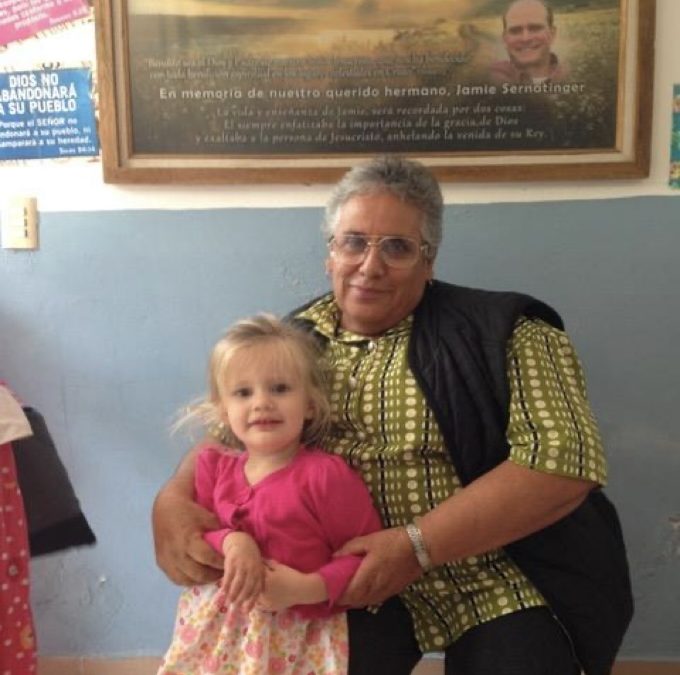
Monica was a kind, outgoing and enthusiastic woman who loved the Lord. She was originally from Celaya, and her husband Jamie was from the States. They had one son named Quico and had lived in Puruándiro for a few years, hoping to plant a church. She frequently reached out to Rosi, inviting her to a women’s Bible study held in a nearby park and to events in the church. Rosi would go because it would be embarrassing if she didn’t, but she was inwardly annoyed.
Her foot, however, was getting worse. The ulcer would not heal, and she often had to go to hospitals in other cities. Her sister, Elena had fallen very ill as well and was dying. Monica and Jamie were very helpful. They drove her to her doctor’s appointments and supported her immensely. Rosi softened towards them, listening more willingly to what they had to say about the gospel. She was slowly beginning to understand more but still would not accept it personally.
“I hear that you are going to the gringo’s church now,” Rosi’s friend Trinidad said as they sat knitting together outside Rosi’s front door. There was a strange tone in her voice. It almost seemed menacing, like a trap ready to snap as soon as Rosi answered.
She faltered, then replied, “Yes.”
“Rosi, you should know better than to do that.” Trinidad had an accusing look on her face. “Maria was telling me things about you, but I wouldn’t believe it. We have been friends for so many years. I wouldn’t have believed it of you to betray the church so!”
Rosi wondered what the Catholic church had ever done for her. But she kept her mouth shut.
“I’m telling you Rosi, you can’t go with those gringos. They preach heresies. They will brainwash you.” Rosi was warned in a similar fashion by many women whom she considered her very good friends. She was afraid to lose their companionship and receive their rejection. So, she hesitated in accepting Jesus as her only Savior. However, the fact that she attended the gringo’s meetings set her apart, and her friends began distancing themselves.
Rosi’s father returned from the States, this time to stay. His age was getting the better of him. They still lived with Rosi’s contentious aunt. Rosi resented them both for how miserable they had made her life.
In November of 2013 Rosi’s father died. Her spirits plummeted. Now what would she do? They had basically lived off of her father’s pension. Her friends advised her not to say anything to the government providing the pension. Let them find out on their own. How would she provide for her siblings without the income?
Monica was the only one who firmly opposed the idea. It was not right for her to touch a single peso after her father’s death. It did not belong to her any longer. Rosi protested, reasoning that she needed the help. But her own conscience convinced her that Monica was right. She had to go inform the government of her father’s death. Monica assured her that God was faithful and would provide for Rosi somehow.
Monica accompanied her to Mexico City where Rosi declared her father dead and explained her situation with her siblings. But there was nothing that could be done. Rosi’s father had not deposited much in their social security account, and because he was not a citizen of the US, very little money corresponded to his family.
They returned home that day with little more than faith that God would somehow take care of Rosi’s family. The next day Rosi’s phone rang. It was the consultant from the office in Mexico City. “It’s a miracle!” the consultant said excitedly over the phone.
“What is?” Rosi was confused.
“We investigated more of your case; we have managed to get a small income for you. It is not much, but enough to survive.”
Rosi had left everyone at the office touched by her story. They wanted to help her somehow, and after researching different laws and files, they were able to get a small profit from the social security account to sustain Rosi and her family.
Rosi and the consultant cried together. Monica came over when she heard the news and they cried together. “You see? God rewards us for trusting in Him!” she said joyfully.
AND THEN CAME JESUS…
A month later the doctors detected breast cancer in Rosi. As they were examining her, they sent her to a psychologist.
“What kind of life have you lived? What problems are you carrying right now?” the psychologist asked. Rosi was slightly taken aback. She explained her situation with her aunt and her siblings.
“All the hardship you’ve gone through has brought you to this point; all the stress and anxiety has caused this cancer,” the psychologist explained.
As Rosi rode home that day she cried bitterly. Her whole life flashed before her eyes, the tears, the desperation, the resentment, it all came tumbling down on her. “And this is the result,” she thought. When she entered the house, Rosi’s aunt asked her what the doctors had told her. After Rosi recounted the day’s events her aunt shrugged. “It’s not my fault,” she said indifferently. Rosi said nothing.
It was the beginning of a rollercoaster journey of surgery and chemotherapy that year. Although she was unable to work, her siblings were sustained with what they needed. It was all a blur for Rosi. The kindness and mercy shown to her by the people from the church and even people from the government who sought to help cover her needs finally broke Rosi. She fell at the feet of Jesus, humbling herself, recognizing her sin and need for forgiveness. She repented of her bitterness and anger against God, first of all, then her father, then her aunt. Looking back, she could see how her aunt had helped her and her siblings when they were left all alone. Although she had been harsh, she had also taken them to the doctors when they needed medical attention and provided for their basic needs.
She realized she did not deserve all the mercy shown to her by God: He had provided for her siblings’ needs while she fought cancer; He had provided money for all the doctor’s appointments and treatments she needed; she had food and a house, and the list went on. She thought she had nothing to thank God for. Now she saw how wrong she was. Yes, life was hard. She had suffered many things. But looking back she could see how God had been with her all the way, even though she couldn’t see Him at the time. The numerous ways He had protected and taken care of her overwhelmed Rosi, first with guilt, then gratitude. Her accusing questions of “Why me? Why do I have to suffer like this?” now became humble questions of “Why me? Why did you choose me to be your child?”
There had been times when Rosi wondered if she was paying for her ancestors’ sin. Why else did she have to suffer the way she did throughout her life? But Monica had told her that she was not paying for anyone’s sin. Jesus had already done that on the cross. God had planned and orchestrated every detail in Rosi’s life with a special purpose. Now she understood what that purpose was, and it made a lot more sense. It humbled Rosi to think that God had placed her in His world, in the little of town of Puruándiro—in her family, to reflect part of His glory, to be a living testimony of His goodness. It didn’t make life any easier, but it gave the hardship purpose.
Rosi sat down with her siblings for lunch. The small square table was set with steaming beans, rice, chicken, and tortillas. Pains were shooting up and down Rosi’s leg, and that morning Gustavo had had one of his epileptic attacks. Rainy season was coming along, and the roof had several leaks. As they prepared to eat, Rosi instructed her siblings to fold their hands and close their eyes. “We are going to thank God for this day and for the food. We have much to be grateful for.” As they bowed their heads Rosi thanked the Lord for His blessings. They were not only words from Rosi’s mouth but welled from her heart. Yes, she had much to thank God for.
Epilogue
Rosi is a great blessing for the church in Puruándiro. Her gentle spirit has touched and impacted lives as people observe her attitude in her difficult circumstances. It was a privilege to get to talk with her, hear her testimony and write it while seeing it lived out in her life. She has encouraged me to grow in gratitude to the Lord. She still struggles with her health and has three siblings at home to care for. Through it all Rosi has stood firm in her faith that God is working out all things for good for those who love Him. I hope her testimony has encouraged you as well!